The Best Entry-Level Rolex Watches Still Worth Buying in 2026
For most people, the first Rolex isn’t just another watch purchase. It’s the watch they’ve thought about for years, maybe longer. And interestingly, the models that tend to leave the strongest long-term impression usually aren’t the flashiest ones in the catalog. 
They’re the simpler pieces. Steel cases. Clean dials. No complicated displays fighting for attention.
Not “cheap,” obviously — Rolex doesn’t really operate in that category — but watches that focus on the core ingredients the brand built its reputation on: durable Oyster cases, reliable automatic movements, strong daily wearability, and chronometer-certified accuracy. In other words, the pure Rolex formula before precious metals, annual calendars, or gemstone bezels enter the conversation.
For a lot of collectors, that simplicity is actually the appeal.
What Makes a Rolex “Entry-Level”?
An entry-level Rolex typically sits at the lower end of the brand’s pricing structure while still delivering the full ownership experience. You’re not sacrificing movement quality, bracelet construction, or finishing standards. You’re mainly giving up complexity and exotic materials.

A steel Oyster Perpetual and a platinum Day-Date may live in very different price brackets, but both still carry the same underlying Rolex engineering philosophy.
Most first-time buyers end up looking at four models:
| Model | Style | Best For |
|---|---|---|
| Oyster Perpetual | Minimalist everyday watch | Buyers who want simplicity |
| Datejust | Versatile luxury daily wear | One-watch collections |
| Explorer | Understated sport watch | Tool-watch enthusiasts |
| Air-King | Aviation-inspired sport model | Buyers wanting something less common |
Oddly enough, many longtime collectors circle back to these watches later in life after spending years chasing more complicated pieces. There’s probably a lesson in that somewhere.
Rolex Oyster Perpetual
The Rolex Oyster Perpetual is arguably the purest expression of the brand today. No date window. No rotating bezel. No GMT hand. Just timekeeping stripped down to its essentials.
Its roots go all the way back to the original 1926 Oyster case, widely recognized as the world’s first commercially successful waterproof wristwatch. Rolex still explains the history of the Oyster architecture on its official technical pages, and you can see how little the core concept has actually changed over the decades.
Current Oyster Perpetual models are available in:
- 28mm
- 31mm
- 36mm
- 41mm
That range helps more than people expect. A 36mm Oyster Perpetual wears very differently from the 41mm version, even though the overall design language remains nearly identical.
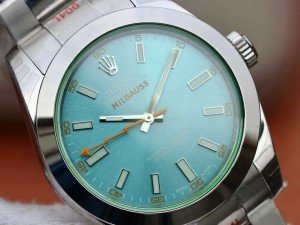
The dial colors have become more playful in recent years too. Turquoise blue, coral red, and green lacquer dials generated enormous demand when Rolex refreshed the line in 2020. Some collectors loved the change immediately. Others thought Rolex was drifting too far into trend-driven territory. The truth is probably somewhere in the middle.
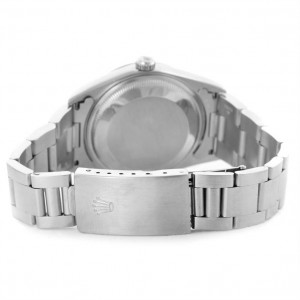
And then there’s the bracelet. Brushed Oyster links, simple clasp, almost no unnecessary decoration. It works with a blazer, but it also looks perfectly normal with a faded T-shirt and sneakers. That flexibility is harder to manufacture than it sounds.
Rolex Oyster Perpetual 124300 vs 114300
The modern 41mm reference 124300 introduced Rolex’s newer Caliber 3230 movement with a longer 70-hour power reserve. The older 39mm reference 114300, meanwhile, uses the previous-generation Caliber 3132.
Here’s the practical difference:
| Reference | Case Size | Movement | Power Reserve |
|---|---|---|---|
| 124300 | 41mm | Caliber 3230 | 70 hours |
| 114300 | 39mm | Caliber 3132 | 48 hours |
The newer movement uses Rolex’s Chronergy escapement, which improves energy efficiency and anti-magnetic resistance. Rolex has discussed the Chronergy system extensively in its movement documentation over the last several years.
In real-world use, the longer reserve genuinely helps. You can take the watch off Friday evening, leave it untouched all weekend, and it’ll probably still be running Monday morning. That may sound minor, but owners rotating between multiple watches notice it immediately.
Some buyers still prefer the discontinued 39mm version, though. The proportions feel slightly tighter and more restrained. On smaller wrists especially, the older watch arguably wears better.
Rolex Datejust
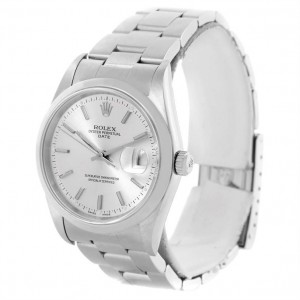
If the Oyster Perpetual is Rolex at its simplest, the Rolex Datejust is Rolex at its most versatile.
There’s a reason the Datejust has remained in continuous production since 1945. Very few watch designs survive eight decades without becoming outdated, yet the Datejust somehow still feels current. Maybe not trendy — that’s different — but permanently relevant.
Originally introduced for Rolex’s 40th anniversary, the Datejust was the first self-winding wristwatch with an automatically changing date display. The Cyclops magnifier arrived a few years later and eventually became one of the most recognizable details in all of watchmaking.
Some people still hate the Cyclops lens, by the way. Others wouldn’t buy a Datejust without it. That split has existed forever.
Why So Many First-Time Buyers Choose the Datejust
The biggest advantage of the Datejust is configuration flexibility.
You can choose:
- 31mm, 36mm, or 41mm cases
- Smooth or fluted bezels
- Oyster or Jubilee bracelets
- Simple baton markers or diamond-set dials
- Steel, Rolesor, or full precious metal construction
That range matters because the Datejust can lean sporty or formal depending on the configuration.
A steel 36mm Datejust with a smooth bezel on an Oyster bracelet feels restrained and modern. Put the same watch on a Jubilee bracelet with a white gold fluted bezel and suddenly it becomes far more traditional, almost old-school in the best way.
For many buyers, the sweet spot remains the steel Datejust 36. It’s large enough for modern tastes without losing the balanced proportions that made vintage Datejust references so wearable in the first place.
And honestly, if someone asked for a single Rolex to wear for the next twenty years without thinking too hard about it, the Datejust would probably be near the top of the list.
Rolex Explorer
The Rolex Explorer occupies a very different space emotionally.
No polished center links. No rotating bezel. No bright ceramic insert reflecting light across the room. Compared to a Submariner or GMT-Master II, the Explorer almost disappears on the wrist — which is exactly why many enthusiasts love it.
The model traces its heritage to the early 1950s Everest expeditions associated with Edmund Hillary and Tenzing Norgay. Rolex has leaned heavily into that mountaineering connection ever since, although historians still debate the exact watches worn during the summit ascent.
The modern 36mm reference 124270 marked a return to the Explorer’s traditional proportions after Rolex spent years producing a 39mm version. A surprising number of collectors were relieved when the 36mm size came back.
The classic 3-6-9 dial layout remains intact, along with the highly legible Chromalight lume.
What’s interesting is how the Explorer wears in practice. Despite measuring 36mm, it doesn’t feel particularly small thanks to the dial opening, lug shape, and bracelet taper. Rolex sizing can be deceptive like that.
And unlike some more attention-grabbing sports models, the Explorer rarely attracts unwanted attention in public. Depending on where you live, that can actually become a serious advantage.
Rolex Air-King
The Rolex Air-King is probably the most polarizing watch in this group.
Some collectors absolutely love the dial. Others think it looks slightly chaotic.
Either reaction is understandable.
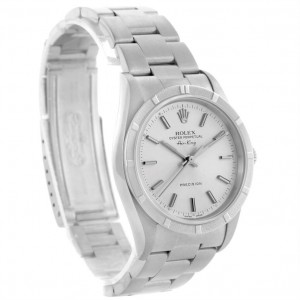
The modern Air-King combines aviation-inspired minute markings with oversized Arabic numerals and a prominent seconds scale that resembles cockpit instrumentation. Compared to the cleaner Explorer or Oyster Perpetual, the Air-King has a much busier personality.
Historically, the model dates back to the 1940s, when Rolex created a family of “Air” watches connected to Royal Air Force pilots. Over time, most of those references disappeared, but the Air-King survived.
Today’s version feels less vintage aviation and more modern instrument panel. Whether that’s a positive or negative depends entirely on taste.
Still, that uniqueness gives the Air-King something many entry-level luxury watches struggle with: character.
Why Oystersteel Makes Sense for First-Time Buyers
Rolex uses a proprietary version of 904L stainless steel called Oystersteel across its modern steel lineup.
Compared to the more common 316L steel used throughout much of the Swiss watch industry, Oystersteel offers stronger corrosion resistance and takes an exceptionally bright polish. That polished-brushed contrast is one of the small visual details Rolex consistently executes extremely well.
You notice it most on the bracelet edges and bezel transitions.
For first-time buyers, stainless steel also tends to make the most sense financially.
Here’s why:
| Material | Advantages | Potential Downsides |
|---|---|---|
| Oystersteel | Durable, versatile, stronger resale demand | Less visually dramatic |
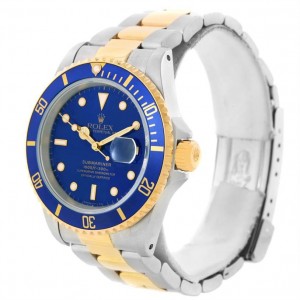
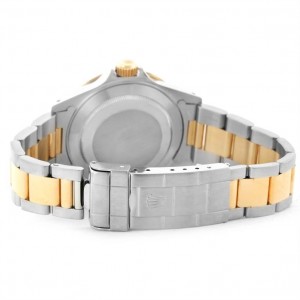
| Two-tone Rolesor | Dressier appearance | Can feel trend-sensitive |
| Precious metal | Prestige and weight | Significantly higher cost |
Steel Rolex models also tend to hold liquidity better on the secondary market. That doesn’t guarantee appreciation, obviously, and the watch market has cooled from its peak speculative frenzy a few years ago. Still, stainless steel Oyster Perpetuals, Explorers, and Datejusts have generally remained resilient compared to many luxury competitors.
That stability exists partly because Rolex tightly manages production volumes while authorized dealer waitlists continue pushing buyers toward the pre-owned market.
It’s basic supply and demand, really. Just unusually amplified.
Vintage vs Modern Entry-Level Rolex Models
This part gets overlooked by first-time buyers surprisingly often.
Older Rolex references can look visually similar to modern ones, but the ownership experience may differ quite a bit.
A few major upgrades changed daily usability over the years:
| Feature | Older References | Modern References |
|---|---|---|
| Crystal | Acrylic | Sapphire |
| Bracelet Construction | Hollow links | Solid links |
| Luminous Material | Tritium | Super-LumiNova / Chromalight |
| Water Resistance | Often 50m | Commonly 100m |
Vintage Rolex watches absolutely have charm. Sometimes more charm, honestly. But they also require more patience and a greater tolerance for quirks.
For buyers wanting a true “grab-and-go” daily watch, modern references are usually the safer choice. 
Choosing Your First Rolex
The best entry-level Rolex depends less on status and more on personality.
Some buyers want maximum versatility. That’s usually the Datejust.
Others want understatement and durability. The Explorer tends to fit naturally there.
Minimalists gravitate toward the Oyster Perpetual. People wanting something slightly unconventional often end up appreciating the Air-King more than they expected.
And wrist size matters more than many first-time buyers realize. A watch that looks perfect in photos can feel completely different after a full day of wear.
That’s why trying them on — if possible — still matters.
Because after all the specifications, movement discussions, resale analysis, and historical storytelling, the best first Rolex is usually the one you keep wanting to put back on your wrist the next morning.